
First up is Tan Gemicioglu. Tan is the current Vice President of RoboJackets and works most often on RoboNav. They work with Professor Thad Starner in the Contextual Computing Group, focused on interfaces for wearable computing devices. This is their 4th semester with the lab. Tan got their start with a project called Silentspeller. Tan describes it as “a silent speech interface using a device that goes onto the upper palate … to detect what is being said by the user. This helps a lot as a privacy-protecting alternative to speech recognition.” The project they’ve been working on most recently is “vibrotactile gloves that passively assist with learning piano and a brain-computer interface using attempted movement to enable communication for people with movement disabilities.”

A watermelon being used as a noise baseline for the Brain-Computer Interface

We also asked Tan what skills from RoboJackets they brought with them to research. Here’s what they had to say:
While we work on people rather than robots, both my technical skills and soft skills from RJ translate very well. We often need to prototype our own hardware for the devices we make and then make sure that our software can be used in real-time. Knowing how to manage people who might have different skill sets is also critical to my work in the lab, since I help newer students in the lab get acclimated.

Next is Daniel Johnson. In RoboJackets, Daniel is the bot lead for Bucki in Battlebots, and is also the mechanical core chair. Daniel does research under Dr. Christopher Saldana in the Enhanced Preparation for Intelligent Cybermanufacturing Systems (EPICS) research team. Daniel’s projects are focused on “manufacturing optimal geometries for lattice structures using laser powder bed fusion (LPBF) additive manufacturing.” LPBF as a technique is similar to other powder- or resin-based 3D printing, in which a workpiece is fused from a vat of material into a 3D object with the specified geometry. He uses computed tomography data (in medical applications, often called CAT scans) “to inspect and study the geometries manufactured and establish quality metrics, occasionally performing mechanical testing to assess relationship between manufacturing defects and structural performance.” This entails “developing algorithms and processes to visualize and analyze CT data of LPBF components as a way to create an efficient and accurate non-destructive evaluation workflow.”
Here’s what Daniel had to say about the skills he brings from RoboJackets to his research:
My experience in RoboJackets has equipped me with essential skills when it comes to working on a team to solve a common problem. Designing battlebots has enhanced my ability to develop creative, abstract ideas and resolve individual contributions of team-members into a global team solution. This experience has prepared me to dynamically function with my research group, allowing me to make meaningful contributions to the group effort.

Volume Graphics segmentation and analysis of CT data from a LPBF manufactured 316L stainless steel sample

This shows a 3D distribution of pores color coded by volume. This graph was generated from the CT images shown in the other photo
]]>This year, the RJ Girl Gang was started to create a welcoming environment for RoboJackets members belonging to a gender minority. Spearheaded by RoboCup member Asha Bhandarkar, the intent of the group is to “provide a social and supportive environment where people [feel] comfortable discussing problems and their perspective about being gender minorities in RoboJackets.” Said Asha: “I think one of [the areas] where [RoboJackets] has yet to make significant gains is our lack of diversity…Over the years, I’ve seen many people who fall under the umbrella of being a gender minority in STEM leave RoboJackets, and this is similar to the trend we see in industry today.” One of the main ways RJ Girl Gang looks to improve retention and foster camaraderie is via monthly socials where gender minorities from all teams in RoboJackets can build relationships and speak about their experiences in a safe environment. The group held its first event on Tech Green last month. Students played field games and had the opportunity to meet in person and get to know one another better. “In the future, I’m hoping we continue to have fun socials and form a tight knit group,” said Asha.
If you are an alumnus of RoboJackets and are interested in helping increase gender diversity in RoboJackets, please reach out to us at [email protected].
]]>We asked Chris Bellflowers, the current shop manager, about the motivation for switching the two rooms. He said, “I first started thinking about the room swap when occupancy limits were placed on shop rooms due to COVID-19. Initially, the electrical room was only allowed to have one person in it, which isn’t enough people for teams to get anything done.” Even before the restrictions were in place, “it didn’t really make sense to have a whole room dedicated to CAD stations that aren’t used often enough to justify the space they take up, whereas the electrical room was used so frequently that it didn’t make sense to have it be so small.” Many mechanical members that CAD do so on their personal machines, so the desktop machines were used less frequently. This work has been a long time coming, as Chris mentioned that he proposed the room swap all the way back in May of this year.
Chris said that he was very pleased with the effort, and grateful for the people who showed up and put in the effort to swap the two rooms.

The team that volunteered to get the room swap done
The work isn’t totally complete, however: “We are waiting on some tools and organization from Milwaukee [originally from a large in-kind sponsorship] to complete the space. I would eventually like to paint the cabinets at the back of the room to give the room some more decoration as well as some backlighting for the cabinets.”
Finally, Chris opened a poll for new names for the new reorganized rooms. The names that RoboJackets came up with and voted for were the “Pixie Palace” for the new electrical room (named after unified pixie theory for electronics) and the “CAD Cave,” drawing on the room’s new purpose and size.

The office, post shop refresh in February 2021

The same space, now the “Pixie Palace”

The old electrical room, now the “CAD Cave”
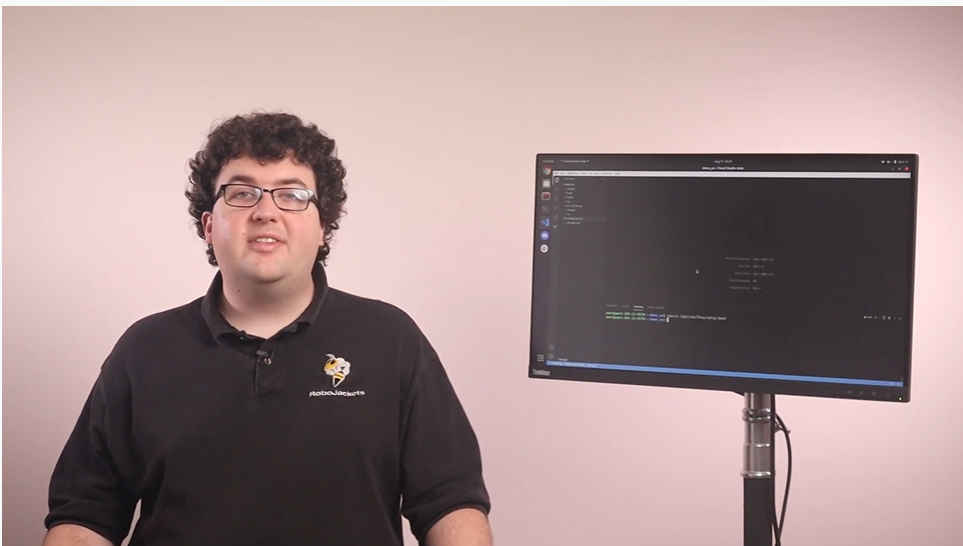
]]>Last year training was delivered through virtual lectures with exercises that members could do on their own time. Now that in person sessions are possible, new members benefit from the best of both worlds. Trainers can provide more personalized feedback on the topics during sessions while giving new members resources to access later or as needed. In this article, we’ll take a look at how the training program has been going so far this year.
There are four main disciplines in the program, which correspond to the different subteams in the competition teams. Mechanical training focuses on the mechanical design process and how to use CAD programs (specifically Autodesk Inventor) to design components and robots. Electrical training teaches about different electrical components and how to use them in PCB design. Software training covers writing code with C++ and ROS and learning some of the fundamental theoretical concepts needed to write code for robots. Firmware training connects software and electrical training by teaching microcontroller programming and prototyping.
Mechanical training is led by Keertik Bacon. The main goal for the training team this year was to make the content easier to understand. The team revised the lesson order to be a more logical progression. The curriculum started with looking at making individual parts, in CAD and manufacturing, and then expanded to assemblies, designing in CAD and assembling in real life. Each lesson builds on the previous. A typical training session is roughly an hour of lecture on the week’s topic and then an hour of practice CAD projects. But another priority for Keertik was to make training less like a formal class or lecture. Students would be attending sessions in the evening after a long day of classes, so he didn’t want it to continue to follow that pattern. “I don’t want to bore people with content that can be dense,” he said. Keertik and the other trainers try to make the session more informal, and each session ends with a Kahoot (online game quiz) as a fun recap of the content. “My favorite part of training [is] interacting with new members,” said Mesum Zaidi, a mechanical trainer. He says that this year has been a lot more interactive than when he went through mechanical training.
Firmware and electrical training have also been going well according to firmware lead Maanas Purushothapu and electrical lead Andrew Rocco. Like mechanical training, firmware and electrical start with a presentation on some new concepts followed by a practice project. But this year they were able to return to in-person labs. “We have had a great turnout,” said Andrew, seeing over 60 new members each week split between electrical and firmware training. The curriculum for each program was mainly based on the curriculum from last year. Last year’s program received positive feedback from the new members who went through it, so it was mainly adapted to be done in in-person sessions. This also means all the video lessons from last year stay pretty consistent with the current content, so members that miss a session can easily get caught up or reference them later.
Software training has seen the biggest changes of the disciplines. If you’ve been following the newsletter, you may know that the Alumni Association has started supporting RoboJackets through different projects, including creating the software training curriculum. There are two goals with this new approach. First it makes training easier for the trainers by letting them focus on delivering the content to new members instead of developing and delivering the content while also working on their team projects. Second, the curriculum fits the needs of the teams better by teaching robotics theory and programming at the same time. This would allow software members to get better acquainted with theory they might not encounter until their third or fourth year at Tech.
Jason Gibson and Matt Barulic have been working hard throughout the past year to create this new training program. Both of them led software training when they were students, and they had big ideas for where the program could go. “It’s been a pretty massive undertaking,” said Matt. They have made slides, lecture videos, and significant improvements to the simulator for projects. Each session is a hybrid of virtual and in-person content. Each week there are videos covering different topics in the three main categories: robotics theory, C++, and ROS. Students can watch the videos on their own time and come to a training session with any questions they may have. The trainers will give a recap on the content, answer any questions, and help the new members through the practice projects that incorporate the learned content.
The catalyst for this shift came in Fall 2020, when RoboJackets had to adapt to the restrictions for COVID-19. The training curriculum before then was focused on teaching C++ and there was much greater variance in technology across teams. Each competition team would train new members on their specific technology stack and related robotics theory during their team meetings. Pandemic restrictions pushed the software teams to create a common curriculum so the training efforts would not be duplicated across teams. The common foundation of concepts allowed software leads more time to teach new members about the projects they were working on and actually work on them. Essentially, this turned training from having two lectures per week to one lecture per week, with more time writing code and contributing to the teams’ code stacks. This shift was the perfect way for alumni to get involved since software training was no longer heavily team-dependent.
Navaneet Kadaba is leading software training this year, and he thinks the new software training program has yielded great results. “I’m just excited overall that we have alumni helping us make content,” he said, “It is very well thought out compared to anything that us students could make.” Both Navaneet and Vivek Mhatre, another trainer, agree that the program has actually helped them understand the material they are teaching better. “I feel like I’m learning even more,” said Vivek. He said that new members ask great questions during the session, thanks to the in-depth curriculum. Matt thinks this is because they are coming at this project as alumni, and not active students. It reframes it as an act of service and “puts pressure [to] deliver a program better than what we’d done for ourselves in the past.”
Matt and Jason still have big ideas for software training. The next big project is reintroducing the physical robots used in training previously. While running code in a simulation has advantages, it’s just not as satisfying seeing a robot interact with the real world using code you wrote yourself. A lot of upcoming work is also focused on polishing what was built this year, improving the lecture visuals and additional resources. If you want to help contribute to next year’s training program, you can reach out to Jason and Matt on the alumni Slack.
You can find more about software training on the software training repo. Additional training resources can be found on the Training page.