The goal in combat robot competitions is to make a weaponized robot that can either destroy its competition or demonstrate enough control and aggression to make it a clear winner. In general, that typically means having a robot with a weapon attached, like a flipper, a spinner, or a flamethrower. Other approaches include building an external shield, like a ring or shell, and spin it around the robot’s exterior. But occasionally, you have a robot that is the weapon (no, I’m not talking about wedges). These kinds of robots spin their entire bodies instead of spinning an isolated weapon. This design is called a melty brain (sometimes called a translational drift robot) and, in theory, they hit harder than traditional spinners. Increasing the weapon’s speed or mass will increase the energy that is transferred to the opponent. At very high speeds, however, the robot cannot move close enough for the weapon to make good contact with the opponent and usually glances off the opponent’s armor. On the other hand, melty brains leverage their entire weight while spinning, which lets them have a high energy output without spinning too fast. However, controlling these robots is a hard problem, so you don’t see them often in competitions. Today we will be looking at RoboJackets’ current attempt at the design with the 12lb robot Hocki.
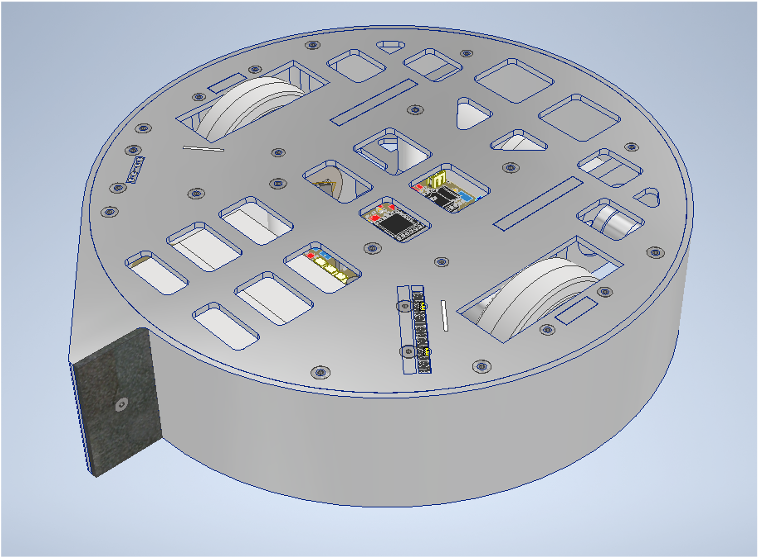

The idea for Hocki started with former RoboRacing electrical lead and current Hocki bot lead Varun Madabushi. He, Juan Elizondo (former RoboWrestling electrical lead), and Afshan Chandani (former Apachi Bot Lead) were attracted to the technical challenge of making a melty brain. Melty brains require more sophisticated electronics and software than most other combat robots, which makes them unique among the other robot designs. On top of that, they were interested in seeing if they could make a larger version since almost all melty brains they had seen were made for 3lb competitions. Because of this, the first step in the design process was research to see if a 12lb robot was feasible. “We needed to see what speed we needed in order to get a robot that hits reasonably hard,” said Madabushi, and they needed to find components like sensors and microcontrollers that could handle that speed. Initial design efforts were spent looking at existing 3lb designs and specifying components.
At first glance, you might think getting a robot that is constantly spinning to move in a straight line seems like a hard problem. And you would be correct. The first step in controlling such a robot well is getting a robust electrical system that can operate at the high speeds necessary. A melty brain can spin at a couple thousand RPM, meaning the components must have a short response time. The principle component, the microcontroller, needs to run in the realm of 100 MHz to make small adjustments several times within a single rotation of the robot. Sensors need to have a high enough refresh rate to pick up on any variations in the robot’s motion within a rotation. Additionally, sensors need to have a minimal amount of error with every reading. As a match goes on, sensors with drift can cause the robot to behave suboptimally and makes it harder for the driver to drive.

Hocki uses four accelerometers, two infrared (IR) sensors, one magnetometer, and a Teensy 4.1 microcontroller (which runs at 600 MHz). The accelerometers use the centripetal acceleration to calculate an angular velocity, which can be used to calculate the robot’s rotation (i.e. where it’s facing). The magnetometers measure the Earth’s magnetic field, which gets the robot’s angle relative to true north. The IR detectors are used to detect an IR beacon the team will put at the arena wall. Having multiple and different types of sensors creates a redundancy to reduce the error in Hocki’s state calculation.
Sensor type selection was only a small part of the design process. The electrical team spent a considerable amount of time reviewing different models of the sensors with different sensitivities, refresh rates, and communication bandwidth. With Hocki spinning around 3600 RPM (60 rotations per second), the accelerometers can saturate from the high centripetal acceleration, meaning they stop giving meaningful readings. Adding the magnetometer and IR detectors help mitigate that, but they come with their own challenges. Most digital magnetometers max out at 20Hz, which means a reading can only be taken every few rotations. The IR detectors require two transmitters, positioned at opposite ends of the arena, to represent a heading of 0 degrees and 180 degrees. Since an IR sensor could pick up a signal from both beacons, the team had to come up with a way to detect which signal is stronger (closer), and therefore, which beacon Hocki is “facing”.
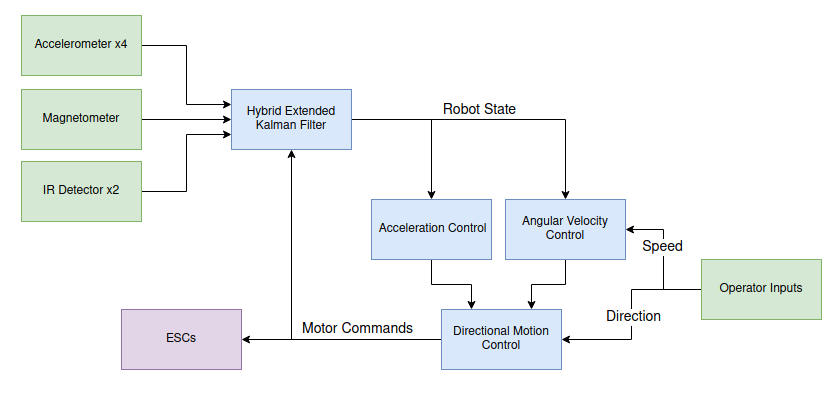
Given this array of sensors, Hocki now has to make sense of and use the data it is receiving. First, the sensor data is passed into a Hybrid Extended Kalman Filter (essentially, a type of nonlinear state estimator). It combines and filters the data to get the acceleration, velocity, rotation, and other data about Hocki’s state. To convey the orientation to the driver, the microcontroller flashes a few LEDs on the top of Hocki, which creates a band of light in the direction Hocki is facing (an example from another robot can be seen in this video). Using a remote control, the driver gives two inputs to the robot: the spin speed and direction of motion. The microcontroller can now control the motion of Hocki by sending commands to the ESCs driving the motors, which are fed back into the Kalman filter.
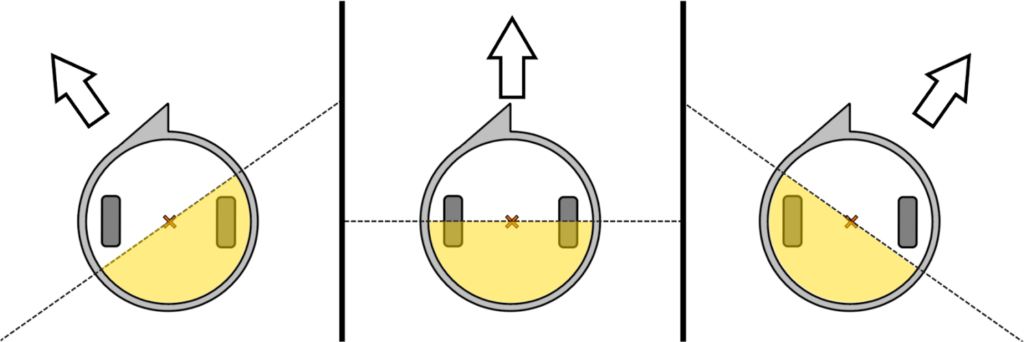
Brief aside about controls: Melty brains are also known as translational drift robots because they work by varying the wheel speeds as the robot spins to cause it to drift in a certain direction. The diagrams below help demonstrate how varying the speeds affect motion. In brief, the wheel “opposite” the direction of motion needs to spin faster than the wheel “closer” to the direction of motion.
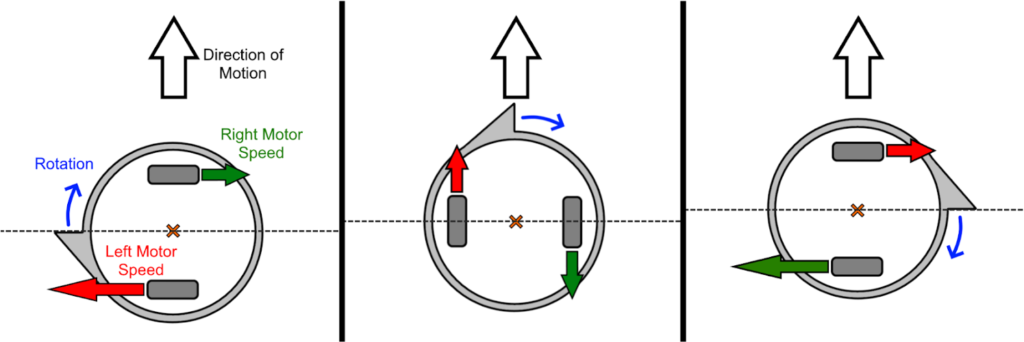
The dotted line in this example splits Hocki into regions to show the further and closer side to the direction of motion. At the start, the left wheel is in the lower region, so it needs to spin faster than the right wheel. As Hocki rotates, the left wheel slows down to match the speed of the right wheel when the wheels are parallel to the direction of motion. As the robot continues to rotate, the right wheel is now further so it speeds up faster than the left wheel. The “faster region” also changes as the driver changes the direction of motion, shown below. The differing speeds cause Hocki to move in an arc, rather than a straight line, but the arcs are small and are chained together to create the impression of moving in a straight line. Controlling the wheel speeds like this is why accurately knowing the orientation and reacting quickly is important. If Hocki is flipped by an opponent, the accelerometers detect it and the microcontroller reverses the rule so Hocki can continue spinning. Aside done.
The firmware that handles motion control was started early in the design and development process. According to BattleBots mentor Keaton Sadoski, the number and arrangement of sensors “was an early concern because it would determine the complexity of the Kalman filter, which would increase the runtime of our control loop.” The microcontroller needs to complete a loop of the control logic in a small, set amount of time for controlling the robot to be feasible. When Hocki is spinning at its full speed of 60 rotations per second, a full rotation takes 16.6 milliseconds, and the time for a control loop is on a scale of microseconds. Due to production delays from the pandemic, getting a full electrical system has been a slow process. The firmware team, without a physical system or sensors, ran simulations using MATLAB to approximate how they expected the robot to behave. This let them get an idea of which Kalman filter to use and how to optimize it. As more electronics have been acquired and assembled, the team has been testing individual components and preparing the system for a full test.

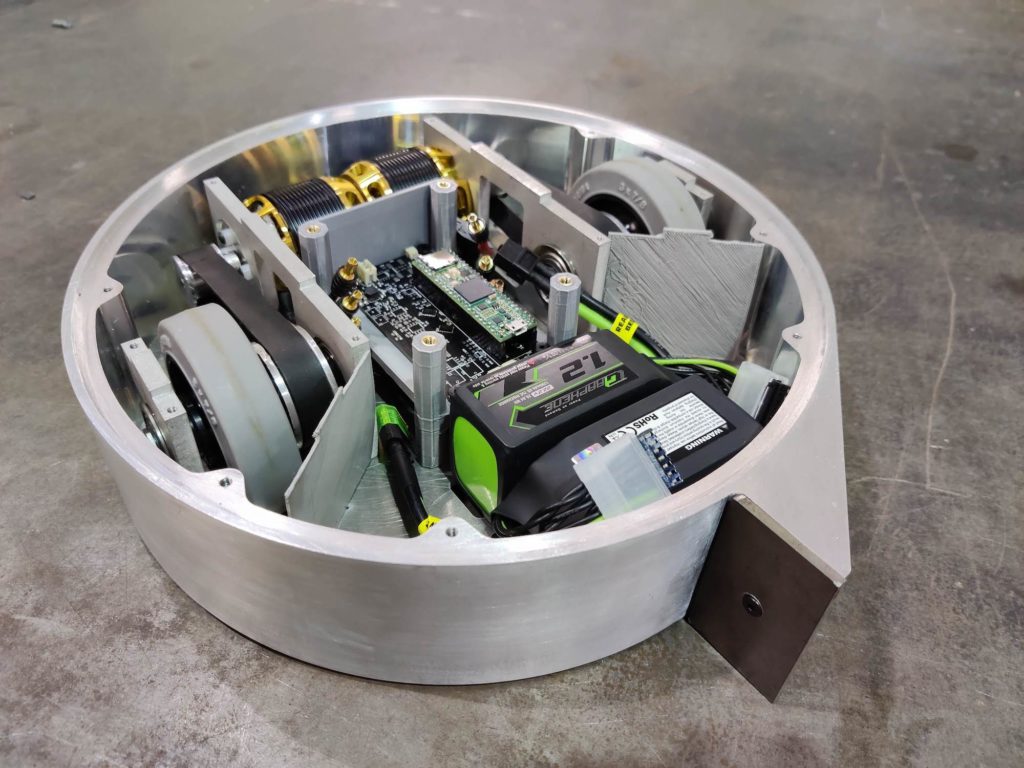
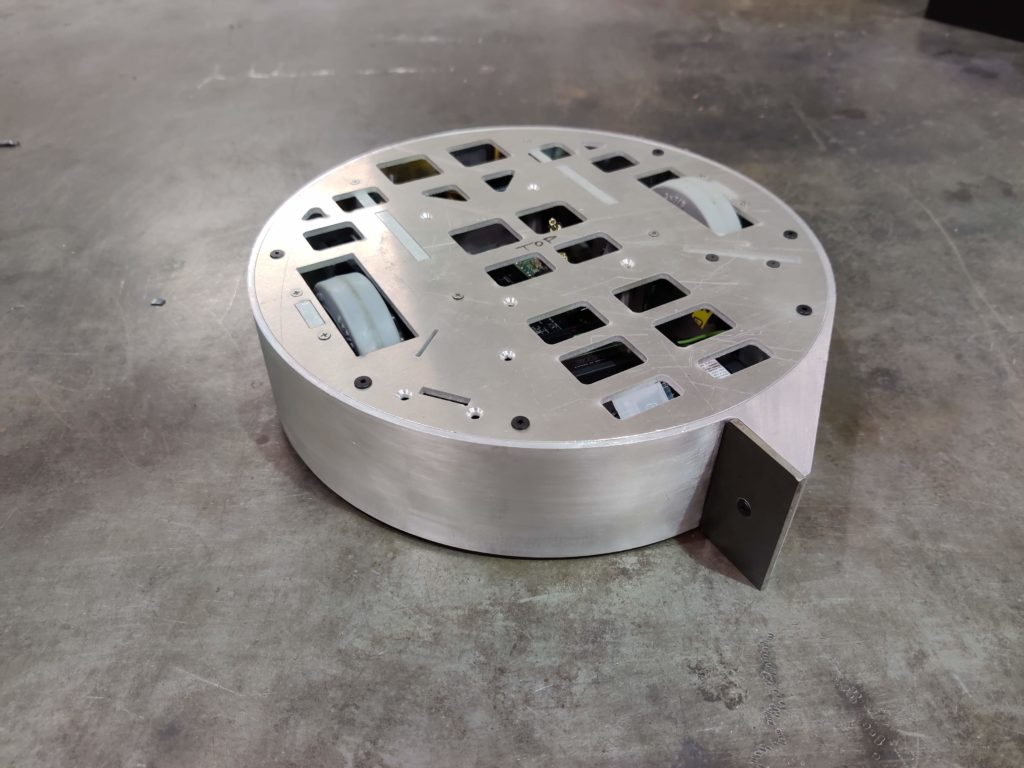
The mechanical designs of Hocki are more complex than most other combat robots due to extra constraints in the design. The first and most important constraint was space for the electronics. The inside of Hocki needs to house the batteries, motors, sensors, microcontroller, radio, and wheels. Additionally, it has the requirement of a balanced weight distribution. Any significant imbalances can make Hocki oscillate while spinning, making controlling it significantly harder. Hocki also needs the structure and armor to protect the critical electronics inside. After deciding on a powertrain that fit their space restraints, the team started with a symmetrical design. The idea allowed them to put two teeth on the outside opposite each other, with the motors balancing out their weight. This design proved to be inefficient with space and made it hard to organize the electronics and batteries. The team settled on a mirrored design with a single tooth. In order to keep the center of mass at the center of the robot, the team experimented with different cut out patterns on the top and bottom plates.
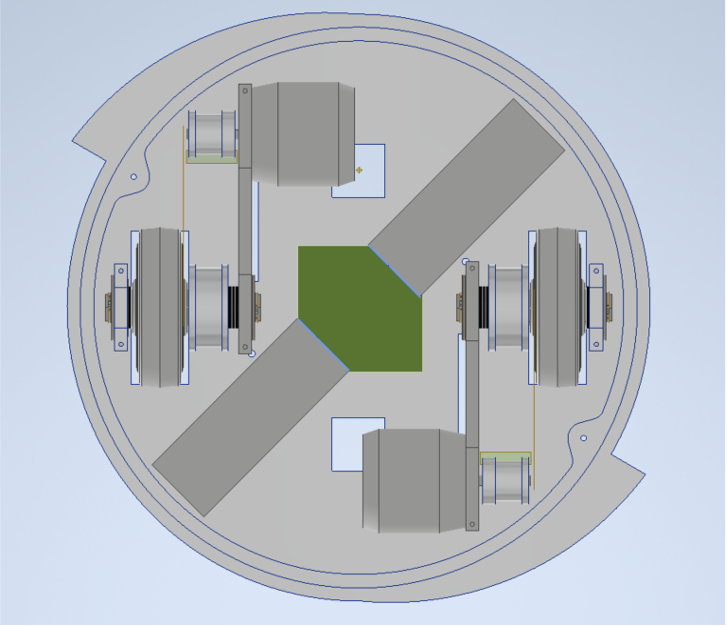
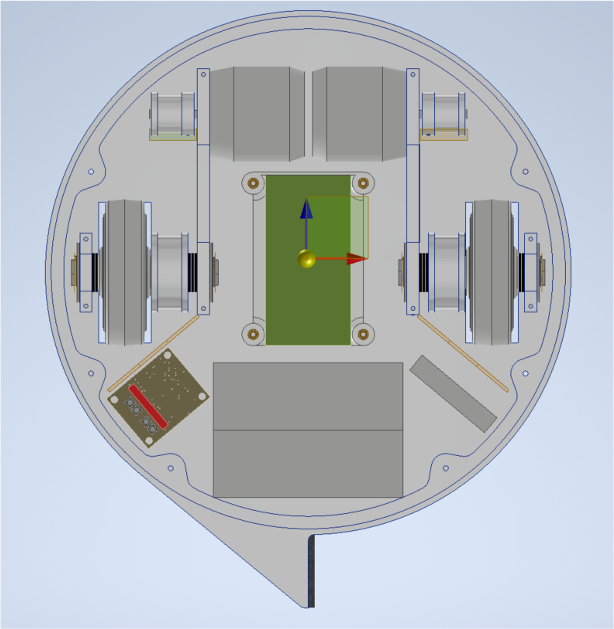
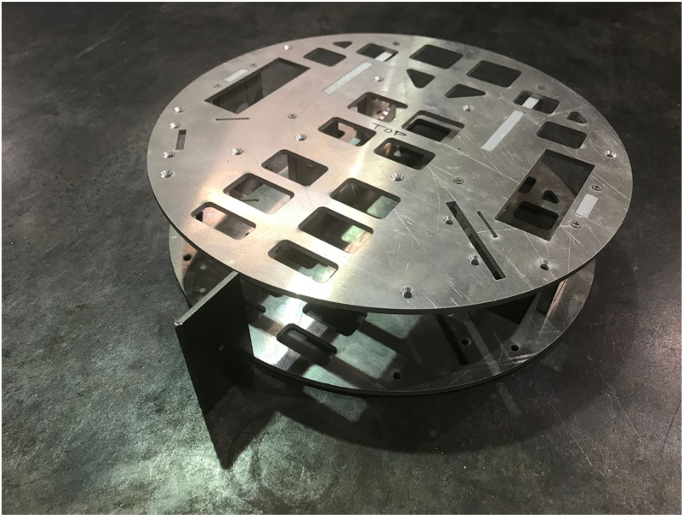
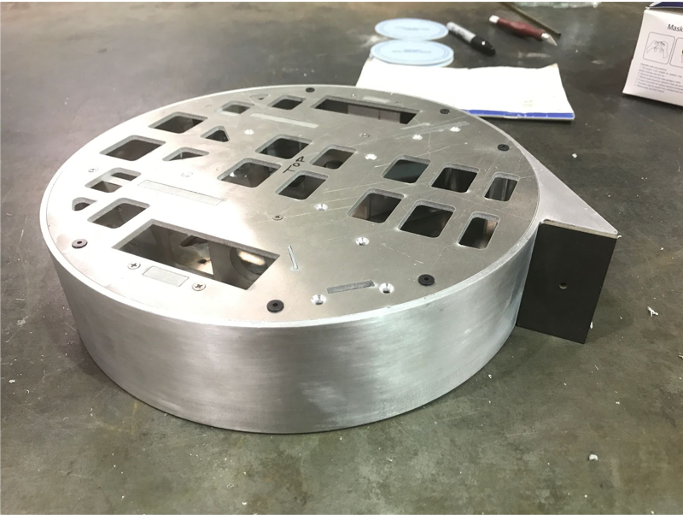
The tight quarters inside meant that maintaining the tolerance of parts was critical to making a successful robot. Significant time was spent making the design easy to assemble without losing precision. With the tight clearances inside, the team needed to avoid tolerance buildup everywhere. The hardest component to make accurately was the outer aluminum ring. To prevent it from deforming when hit, the ring is a solid piece of aluminum with an integrated tooth. The tooth itself is protected by a piece of steel plate to ensure it can cut into an opponent without degrading on impact. The team decided to outsource the machining of the ring because of the required precision and the limitations on the SCC’s machine shop due to COVID-19. The result, shown below, was “totally worth it” according to Madabushi.
Currently the team is working on fine tuning the drive system. Hocki is mostly assembled and many of the electrical components are being tested. Due to pandemic precautions, the team is not attending a competition this year, so they are taking their time making things work well. By the end of the semester, the team hopes to be doing full scale testing of Hocki at its hypothetical max rotation of 3600 RPM.
With a new generation of leadership coming in to take the helm, we here at the Alumni Newsletter wanted to take a look back at previous leaders and their journey through the RoboJackets leadership ladder. We specifically chose to hold short interviews with the previous two Presidents, Alex Field and Joe Spall, to get an idea of who they are as leaders and offer them a chance to share reflections on their role as President and the path they took to get there.
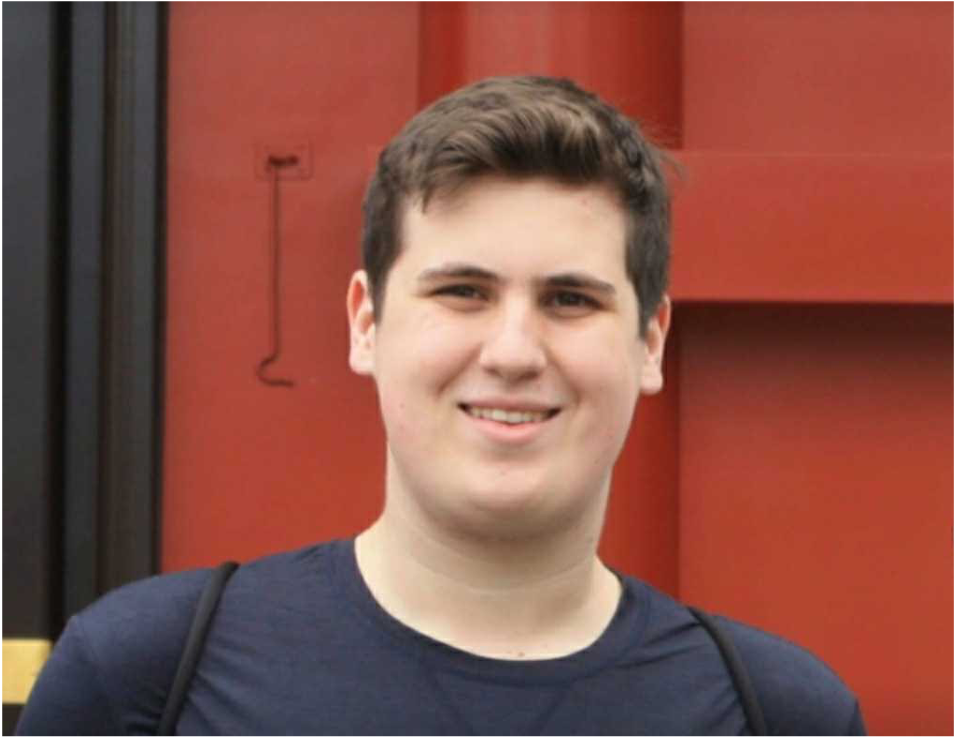
First, we’ll discuss Alex Field, the outgoing President during the 2020-2021 year. Alex started in Battlebots, and quickly began taking on leadership roles in the team, including Sumo bot lead, before the official formation of RoboWrestling this year. The year before he was elected President, Alex was the Project Manager of Battlebots. At first glance, Battlebots is similar to RoboJackets as a whole in that the team is composed of a larger set of smaller teams that operate under the same administrative umbrella. We asked Alex whether he thought that similarity helped prepare him for the role of President. Here’s what he said:
I actually think [RoboJackets President] is pretty different, mainly because all the teams on Battlebots, while they are different, they still share a unified culture … They fit within the Battlebots style. When you’re leading all of RoboJackets, all the teams of RoboJackets are very unique in how they interact with each other, how they interact with their teammates, and the culture that they bring out. You have to adjust to understanding all those cultures. The paperwork and admin side of things is fairly similar … you just have to adapt to the different teams.
Next, we asked Alex about his motivation for getting into leadership. Many people who know Alex will attest he has plenty of energy to spare and is always happy to use it to make a positive contribution, and his answer reflects that well:
I have a passion for helping as many people as I possibly can and doing as much as I can for the people around me. Becoming President was the way I could impact the most people in this organization. I always wanted to see, “how can I take a step up and have an impact on more people’s lives?” [The presidency] was the way I found I could do that. … This organization impacts all the students. By being part of this organization, the members are gaining a unique experience: growing as engineers, growing socially, growing their leadership skills … by helping this organization iron out the issues that happen or handle all the [proverbial] fires that come up, it can make it a smoother process for all the members … they can focus on learning and making things better for themselves.
Speaking of proverbial fires, the year of 2020 had one big one we’re still putting out now. We asked Alex to reflect on the COVID response he and his team executed to keep RoboJackets functioning.
Well, our response wasn’t perfect but we did about as well as we could. …I think the most important leadership trait is adaptability. I think we were quick to adjust our expectations for the year. … We needed to be focusing on making sure we function and getting us to the next year. … We were quick to get announcements out to the organization on what’s going on; we wanted to have as many meetings as possible to iron out all the details so we came into the fall with a plan. … When we got into the fall, people more or less had an idea of what the system was and how we were operating, and teams were able to get to work.
One of the big things that Alex mentioned as part of their planning and communication plan was a Q&A document that the team compiled by asking RoboJackets members for their questions and concerns and finding answers for their specific questions. They then published the resulting FAQ, and actively added information to it as the year went on.
Given this massive (proverbial) fire that Alex and his team had to dedicate significant amounts of time to, there were many ideas that had to be deprioritized. We also asked Alex for some examples of what he had planned to do, but regretted being unable to get to.
I really wanted to see how I could interact with people in SGA [and other student organizations, including SCC teams] and get closer and get to know them a lot more. Everyone was overwhelmed with the pandemic and everything being remote. It was a lot harder to have casual interactions. … I lost the opportunity to build up those [interpersonal] connections I really wanted to build up. …
I don’t want me or any part of this organization to be closed off from those external bodies, because those external bodies bring a unique perspective. … Maybe they have a cool leadership system that they use that we can implement here. We aren’t going to know unless we talk with them. I wanted to be at the forefront of discovering those details and bringing them back to help the organization grow.
He also wanted to spend significantly more time interacting face to face with regular members that may not be involved with RoboJackets leadership. He wanted to get more visibility on core officers and let regular members see them around. After all, “this organization is nothing without the people that make it up. The interpersonal relationships and how we all work together, how we grow from each other is what makes RoboJackets what it is. … I want to be able to strengthen those connections as much as possible.”
Finally, we wanted to ask what Alex did during his time as President that he was most proud of. His answer: “that we made it.”
I’ve been able to talk with new members who have loved their experience as part of this organization [despite all the challenges with COVID] and wanted to continue. Our membership is still large, our retention is still solid. We managed to hold this org together, as much as every external factor was trying to keep that from happening.
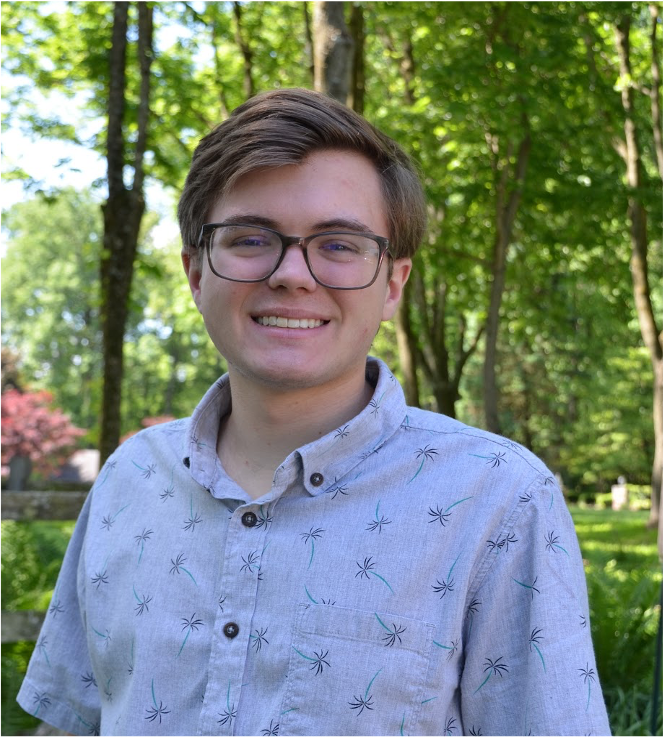
Joe Spall was the President of RoboJackets during the 2019-2020 year. Before he took the title of President, he was a member of RoboRacing and took on a few leadership positions, including RoboRacing electrical lead as a sophomore, the electrical training chair, and the electrical core chair. Electrical core is a biweekly meeting in which electrical members share progress updates and can ask questions to other electrical members in other teams. Joe views his journey through leadership at RoboJackets following the “stepping stone approach.” He continued:
Freshman year, my intention wasn’t necessarily to be a leader in an official position. I wanted to build robots. … Because of the [small] number of people at the time, I was just kinda made the electrical lead, because there were no other people. … I had done leadership opportunities before in high school (chief engineer in his FTC team), but that was the first time, at a more serious level, that I had the technical and the management aspect combining, which I think is important. The President doesn’t necessarily build any robots, but still needs to have the general sense that we build robots and [know] what needs to happen to facilitate that. …Electrical lead helped prepare me for general RoboJackets leadership. … Electrical training exposed me to all the other teams. Like it or not, there’s a bit of siloing that happens at the subteam level… electrical training lead allowed me to see past that. … There’s more to it than building my robot. There’s building the organization and building new members into being part of the organization. Electrical core offered a similar deal, but was a little more administrative.
Like Alex, we also asked him what his motivation was to delve deeper into leadership. He said:
I think there’s more to it than building the robots. This is a leadership organization as well. Having the opportunity to help the next generation, and, of course, current generation, build towards keeping the boat afloat and, hopefully, make it go a little bit faster.
We wanted to highlight two projects he worked on as President: the development of software training robots and the tabling demo hackathon. The first project, the software training robots, involves the design and fabrication of a fleet of simple robots that the software members in software training can use as test beds to help them learn basic coding practices. Here’s what he had to say about his role in their development:
That was actually started up before I was President. Once again, it was about getting to work with other people across all the teams in software. …It was more of a product design experience, which is sometimes more useful in understanding constraints and what people are capable of and committing too. Building a product doesn’t seem like a management thing, but it can be. … I was still working on it a lot as President. … Filling in those gaps is a major part of the President role.
His big takeaways from that role were these:
People are unpredictable. Users are unpredictable. You can see a lot of parallels between that and leadership and managing people. People take different approaches to things and use tools [in ways you may not have thought of] when you originally conceived them. … [also that] things won’t necessarily work out as you expect, but you can get it working enough that there’s still value to it and people can still get a learning experience from it, even if it’s not what you initially envisioned.
The tabling demo hackathon was a big proposal during Joe’s presidency. Joe wanted to do it because “we do a ton of great stuff, but how we communicate that to other people could use some work.” RoboJackets has a lot of opportunities to table at various events, but often lacks exciting demonstrations that could be deployed on a tabletop. To rectify this, each team picked a small project that would demonstrate what their team does. The teams then spent a couple days to rapidly make their selected demos. At the end, Joe thought the project was pretty successful:
It’s better [at tabling] to have something you can point to. …From the tabling events we had using the [demos] we made from it, you could see people making better connections with what we were doing. At the minimum, it looks cool, because it’s a robot and people like robots. It was a really cool opportunity for other teams to interact with each other. I think it’s still something we could do more. … Just being 5 individual teams that build robots is good and all, but I think there’s more to it. … It was another opportunity to show other people in the RoboJackets org [that you might not see every day that] you have similar goals.
We also asked Joe if there were any things he wanted to get done during the presidency that he didn’t get to. He cited sponsorship as something that he wanted to devote more attention to. “I worked a lot on the sponsorship stuff for the organization, like finding new sponsors and working with some old ones, and also to get new ones set up. Some worked out, some didn’t.” One sponsor he was excited to bring on was Aptiv, a rapidly growing self-driving car company. He continued: “There’s more sponsors I would have liked to have brought on because they’re cool places to work.” In particular, he wanted to find other companies that offered interdisciplinary work, like tech startups and other smaller companies that work on interesting, interdisciplinary projects. However, since many of these companies are small, it’s difficult for them to commit to a sponsorship.
Finally, we concluded by asking what parts of his presidency he was most proud of. His response:
]]>With some of the leadership cores that I organized, I saw a new generation of leaders coming in and getting the confidence they needed to become future leaders. I’m seeing a lot of those members that participated in those conversations now running for President and Project Manager [roles]. … Keeping the message and the idea [of what we do] alive was my biggest contribution. … As some might say, [to] Promote, Educate, and Advance.
RoboJackets has been growing in size and complexity over the last decade. Because of the flourishing membership we’ve also had success with alumni retention: “old people” who are interested in sticking around to help out even after they’ve graduated. This has been happening for a few years, and the alumni who have been working behind the scenes finally saw a good time to make it official.
In the last month, a small group of alumni that have been especially involved held meetings to create a constitution and elect officers to form the RoboJackets Alumni Association. The alumni association enables alumni to continue helping RoboJackets even after they’ve left Georgia Tech and formalizes an effort that already existed. The association also allows alumni to stay connected with other RoboJackets alumni. Because of this, alumni can now share career opportunities and social groups with each other.
The alumni group plans to focus on supporting current students in specific and limited ways that do not impede the typical RoboJackets experience. The alumni do not intend to take on student responsibilities, or solve the problems that RoboJackets members use as growth and leadership opportunities. A major goal mentioned frequently at the preliminary alumni meetings is to remove “suffering for sufferings’ sake” from the RoboJackets experience when possible.
The mission statement of the RoboJackets Alumni Association is as follows: Serve and empower current students and alumni through connection and engagement for a focused, healthy, and positive RoboJackets experience.
The work the RoboJackets Alumni Association wants to accomplish can be divided into 4 basic categories: Hard Problems, Mentorship, Money, and Alumni Groups.
Hard problems include issues like space, retention, and overbearing challenges that are larger than the effort of a single student or group of students during the typical four year tenure.
The alumni association wants to foster mentorship between alumni and current students because alumni have meaningful experience in RoboJackets as well as the outside world to offer current students. The alumni association seeks to utilize that experience to mentor RoboJackets students in the areas they are knowledgeable and passionate about to help the members of RoboJackets grow.
To help alleviate monetary challenges, the RoboJackets Alumni Association has established the RoboJackets Operational Endowment within the Georgia Tech Foundation. This fund will be built and used to pay for large expenses (such as new large equipment, etc.).
While these are in their early stages now, the alumni association would like to facilitate alumni connecting in small groups based on their geographic locations in the US and around the world. This is intended to mirror the Georgia Tech Alumni Association’s approach to connecting Georgia Tech graduates across the globe.
The RoboJackets Alumni Association already has a few tools to stay connected. The first is the LinkedIn group: RoboJackets Alumni Group. Currently, the LinkedIn group is used to communicate about the RoboJackets Alumni Newsletter and to share career opportunities through an official channel. The second is the new Slack workspace! This new Slack workspace allows alumni to communicate without eating into the message history of the RoboJackets Slack. Click this link to join! (It will only be active until April 26, please email Sarah Storer, current President of the RoboJackets Alumni Association, at [email protected] if you need assistance or need a new link.) Finally, the RoboJackets calendar has events marking monthly meetings where alumni discuss and vote on alumni project proposals. You can find that here: RoboJackets Alumni Association Meeting.
]]>Every year around late March, RoboJackets elects a new group of core officers. This is a great opportunity for passionate members to identify themselves and be identified by others, and for the rest of the organization to directly influence the path of RoboJackets for the next year. To be eligible for a position, a person must be an active member of RoboJackets for at least one semester. The positions of President, Vice President, and Treasurer may only be held by a person with at least one year of membership. A few weeks before the elections are set to take place, members can nominate people (including themselves) to run for any of the elected positions. A member must be nominated, seconded, and accept their nomination in order to run.
During election night, the process begins with the President position, followed by Vice President, Secretary, Shop Manager, Promotions Chair, and Outreach Chair, which until recently was a PM position. All candidates running for a given position will leave the room, individually returning to deliver a speech and take questions from attending members. This allows each candidate to deliver their platform without being influenced by their opponents’ ideas. Once every candidate has given a speech and field questions, the rest of the attending members will engage in a deliberation period where they discuss each candidates’ strengths and weaknesses before moving to a vote and electing a new officer. Candidates that weren’t elected have the option of running for next position in the process.
This process has some advantages, as it allows attending members to learn about each candidate’s platform in detail before voting, and gives them the opportunity to bring up discussion points about candidates that they might not otherwise be comfortable speaking about. However, the intent of the discussion period is usually to bring the attending membership towards a consensus; as a result the election meeting regularly takes several hours.
This year’s newly elected core officers are:
President: Shishir Pandit-Rao
Vice-President: Tan Gemicioglu
Treasurer: Cade Tyler
Secretary: Sana Hafeez
Shop Manager: Christopher Bellflowers
PR Chair: Shail Patel
Outreach Chair: Malak Bayyari
]]>